
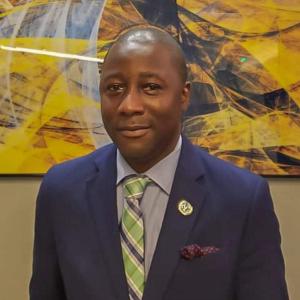
Chinese Ambassador discusses tripartite cooperation between Sierra Leone, the United Nations & China.

The RC also emphasised the importance of strengthening national data systems to support evidence-based policymaking and development planning.

Strengthening cooperation between the UN Country Team and the People's Republic of China in support of Sierra Leone's development priorities was the focus today of a courtesy call by the UN Resident Coordinator (RC), Ms. Seraphine Wakana, on China's Ambassador to Sierra Leone, H.E. Mr. Zhao Yong.
RC Wakana congratulated Ambassador Zhao on his appointment and expressed appreciation for China's collaboration with Sierra Leone during its tenure as a non-permanent member of the United Nations Security Council from 2024 to 2025. "We see and appreciate China's support through its engagement with Sierra Leone and the United Nations," the Resident Coordinator noted.

She underscored the importance of coordinated partnerships to advance Sierra Leone's national development agenda while reflecting on the ongoing constitutional reform efforts ahead of the 2028 elections. She also highlighted the role of the UN as one of the moral guarantors of the Agreement for National Unity and the related Tripartite/Cross Party Committee Report, which produced 80 recommendations aimed at fostering dialogue, accountability and national cohesion following the 2023 elections.

The RC further discussed key development priorities being supported by the United Nations in the country, including women's and youth empowerment, support for inclusive electoral processes, responding to cross-border challenges, addressing issues affecting young people such as drug and substance abuse, enhancing security, and promoting sustainable management of natural resources. She stressed the importance of promoting peace, stability and social cohesion as essential to advancing sustainable development and preventing the emergence of conflict drivers. In this regard, RC noted that through the UN Secretary-General’s Peacebuilding Fund, the UN is supporting the country to advance a prevention agenda, which is a crucial enabler for accelerating development efforts.

Ms. Wakana also provided an overview of the UN Sustainable Development Cooperation Framework (UNSDCF) 2025-2030, which is aligned with Sierra Leone's Medium-Term National Development Plan 2024-2030. She highlighted the Framework's three strategic pillars and called for stronger collaboration with China, particularly in agriculture, where the country has extensive experience and proven expertise.
The RC also emphasised the importance of strengthening national data systems to support evidence-based policymaking and development planning, an area that remains a key priority for the UN Country Team.
Ambassador Zhao reaffirmed China's commitment to supporting Sierra Leone's development aspirations in partnership with both the Government and the UN. He noted that China remains the second-largest contributor to the United Nations regular budget and peacekeeping budget, accounting for approximately 18.7 per cent of UN peacekeeping funding while providing substantial support to global peace and development initiatives.

The Ambassador reflected on the longstanding friendship between China and Sierra Leone, which spans more than five decades, and highlighted China's continued support for the country's development priorities through projects aligned with the Government's "Big Five Game Changers" agenda, particularly in agriculture, health and education.
He noted that the 15th batch of Chinese agricultural experts is expected to arrive in Sierra Leone soon to support agricultural development and food security efforts.
Ambassador Zhao also outlined China's contributions to Sierra Leone's health sector, including the deployment of three medical teams currently serving in the country. In addition, he highlighted China's support for human capital development through training opportunities for Sierra Leoneans.
The Ambassador further noted China's collaboration with several UN agencies, including support to schools through initiatives with UNDP, assistance to hospitals in reducing child mortality in partnership with UNICEF, and cooperation with the World Health Organisation on HIV/AIDS programmes and mobile medical services.


Written by
Osman Sankoh
UN entities involved in this initiative
Goals we are supporting through this initiative


