Resident Coordinator, Babatunde Ahonsi discusses youth issues with youth affairs minister
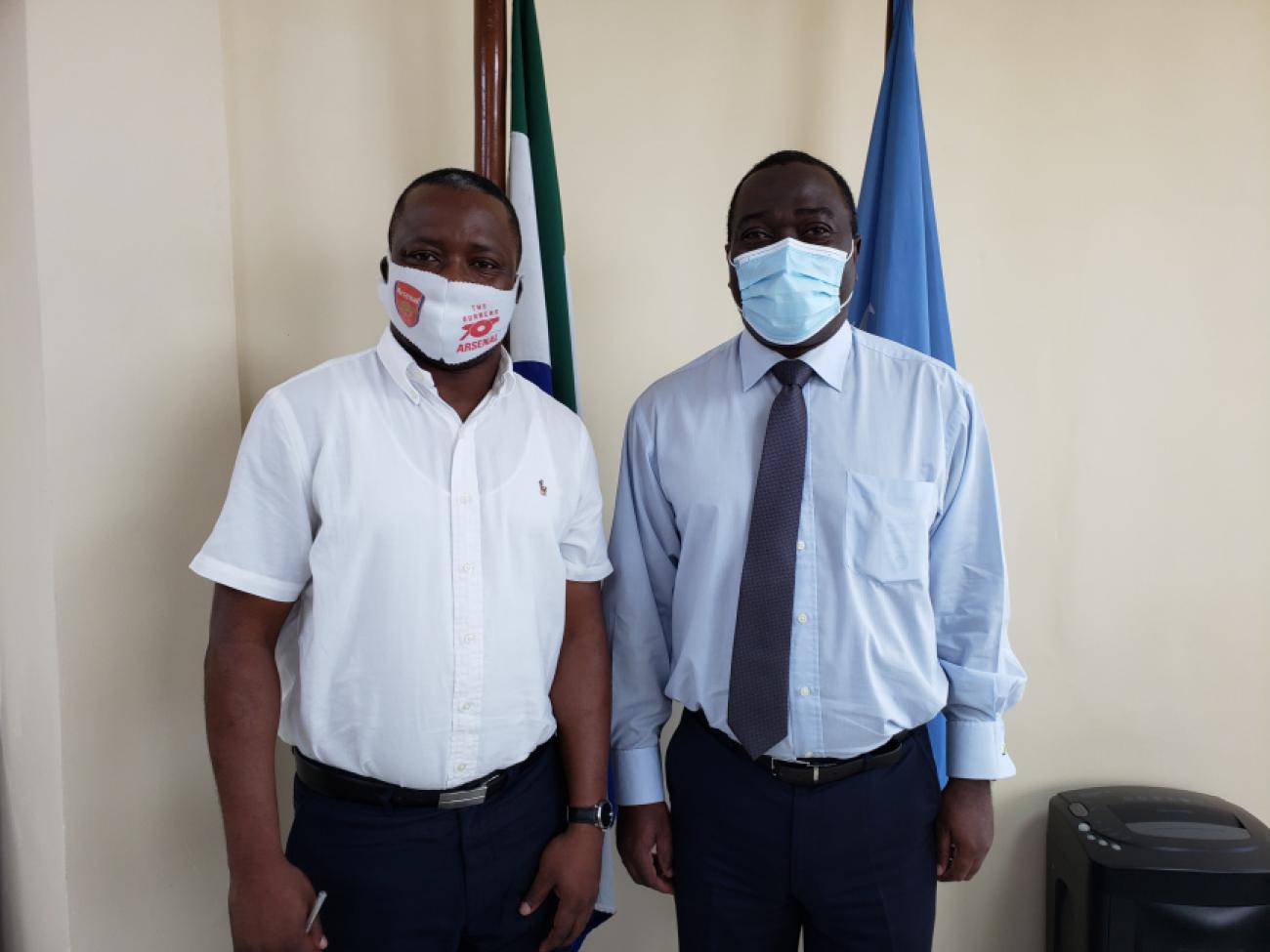
UN RC Dr Babatunde Ahonsi in his first engagement with the Minister of Youth Affairs, Mr. Mohamed Orman Bangura.
UN Resident Coordinator Dr Babatunde Ahonsi in his first engagement with the Minister of Youth Affairs, Mr. Mohamed Orman Bangura said, “Young people, especially in countries like Sierra Leone, represent an asset for realizing the development potentials of the country”.
Speaking at the meeting which took place at the UN Resident Coordinator’s Office on 3 November, the RC said, “If you invest in their health, their education and run the economy in a way that generates decent employment for young people, you will almost inevitably as a country reap a significant demographic dividend fifteen to 25 years down the line”. He then gave examples of countries in East Asia such as Thailand, the Philippines, South Korea, and China, where this has happened. Dr Ahonsi said that the data shows clearly that up to about 20 percent of the very high rate of economic growth that China witnessed between the early 80s’ and 2010 was attributable to that additional boost given by the demographic dividend. In this regard, he described investment in young people as “an economic and moral imperative” that needs to be prioritized.
Dr. Ahonsi also commended the Government’s development priorities that include investment in the sectors and areas that significantly benefit young people, particularly the emphasis on human capital development. For the RC, young people must be engaged to have a sense of belonging and “stakeholdership” in society and be seen as both agents and beneficiaries of the country’s quest for rapid economic growth and social transformation. He reiterated the UN country team’s laser focus on supporting development efforts that leave no one behind, especially the young people of Sierra Leone.
Minister Bangura, in his response, expressed his appreciation for the RC’s emphasis on the role of youth in development. He informed him that President Julius Maada Bio, “looks at us the youth as assets,” and emphasized that young people must be seen as partners in development.
Mr Bangura said that there is increasing trust, accountability, and transparency in the Ministry of Youth Affairs. However, the biggest challenge is how to change the mindset of young people. To mitigate this, the Ministry, under his leadership, has implemented programmes to engage the youth in activities not only productive to themselves but also to their communities. The Minister said he is also using opportunities provided for in the National Youth Policy, a process he described as consultative and participatory.
Minister Bangura was accompanied by his Permanent Secretary, Mr Andrew Sorie, and the Director of Policy and Planning, Mr Marlon Bockarie, who also briefed the RC on the current status of the Youth Policy. They also briefed on how the youth are in the decision-making process, from local to the national level.


Written by
Osman Sankoh
UN entities involved in this initiative
Other entities involved in this initiative
Goals we are supporting through this initiative