
Latest
Story
09 April 2026
“Service Users” tell UN ASG: “We are ready to be Ambassadors of Positive Change.”
Learn more
Story
03 April 2026
Day Three in Sierra Leone : From climate action to disability dights, UN Youth Affairs ASG amplifies Sierra Leonean voice.
Learn more
Story
01 April 2026
Day One in Sierra Leone: UN ASG urges Investment in young people for Sustainable Growth.
Learn more
Latest
The Sustainable Development Goals in Sierra Leone
The Sustainable Development Goals are a global call to action to end poverty, protect the earth’s environment and climate, and ensure that people everywhere can enjoy peace and prosperity. These are the goals the UN is working on in Sierra Leone:
Story
09 April 2026
“Service Users” tell UN ASG: “We are ready to be Ambassadors of Positive Change.”
“Service Users” Tell UN ASG: “We are ready to be Ambassadors of Positive Change” Five weeks into their eight-week rehabilitation programme for Kush addiction, the leadership of the 99 inmates at Hastings Rehabilitation Centre delivered a heartfelt appeal on Good Friday, asking the international community to support their reintegration into society, where they aspire to serve as Ambassadors of Positive Change. Now called Service Users, they met with Felippe Paullier, the United Nations Assistant Secretary-General for Youth, during his week-long visit to Sierra Leone to engage national leaders and partners on youth issues.The meeting took place at the Peace Mission Training Centre (PMTC), a Republic of Sierra Leone Armed Forces (RSLAF) facility hosting the rehabilitation centre. The ASG listened to success stories from individuals who had once been addicted to Kush but, after rehabilitation, returned to society to pursue education or productive work.One young man shared how he had lost both parents shortly after sitting his West Africa Senior School Certificate Examination (WASSCE). In his grief, he turned to Kush, tramadol, and cocaine. His elder brother brought him to the centre, where he was rehabilitated; he is now focused on his education and going to church.Kush is a synthetic psychoactive drug formed from dangerous combinations of opioids and cannabinoids. It emerged in Sierra Leone around 2022 and spread rapidly among young people due to its low cost and high potency. The drug has caused severe addiction, mental health breakdowns, and physical deterioration, tearing families apart and leading many youths to drop out of school, lose jobs, or turn to crime to sustain their addiction. A police officer dismissed from the Force for absence without leave due to the effect of Kush on him was one of the service users the ASG met. Economically, Kush has undermined productivity and placed heavy burdens on the healthcare system. By April 2024, the crisis had escalated to such a level that President Julius Maada Bio declared Kush a national health emergency. The government launched interventions to expand treatment, rehabilitation, and community awareness. There are four rehabilitation centres across the country, and Hastings is home to the seventh batch of Service Users admitted there.The Service Users emphasized that reintegration is key to sustaining their recovery. “We want to return to skills and education because if we are helped, we will be in a better position to help others,” they said. Another added, “We are drug addicts, but that does not mean our hopes end here.”Drawing on his own family’s experience, (his mother works at a rehabilitation centre in Uruguay), the UN ASG encouraged them not to let addiction define them. “You have an identity that is stronger than this,” he told them, promising to raise their concerns with the wider UN in Sierra Leone. He noted that his presence at the centre was already a step in that direction.Welcoming the ASG, Colonel Abdul Baba Keita, Commandant of PMTC, described the Kush crisis as a detriment to Sierra Leone’s human capital development and stressed that the RSLAF is working closely with the Ministry of Social Welfare to complement government efforts in addressing the menace. Mr Gbangay Kanu, Deputy Director of Mental Health and Psychosocial Support Services at the Ministry of Social Welfare, outlined the challenges faced by service providers, noting that the Government covers the feeding and overall well-being of the Service Users. He called for partners to join in supporting key components of the programme, including reintegration into their communities.The Service Users’ journey from addiction to rehabilitation to advocacy reflects Sierra Leone’s broader struggle against Kush. Their call to be Ambassadors of Positive Change is both a plea for reintegration and a reminder that recovery is possible, and that youth can lead the way in rebuilding communities devastated by the epidemic.

Story
03 April 2026
Day Three in Sierra Leone : From climate action to disability dights, UN Youth Affairs ASG amplifies Sierra Leonean voice.
On his third day in Sierra Leone, UN Assistant Secretary-General for Youth Affairs Dr. Felipe Paullier met with youth advocates convened by UNFPA and UNICEF. Discussions focused on ending teenage pregnancy, child marriage, and FGM; promoting gender equality; strengthening adolescent wellbeing and access to services; and elevating youth-led responses to climate change and resilience-building. They also explored how innovation, digital inclusion, education, skills development, and entrepreneurship can expand opportunities and reduce exclusion, while advancing youth influence in policy and decision-making. At the roundtable, youth leaders, including Esther Yealie Kamara (climate advocate), Mohamed Turay (digital champion), and Hassan Bangura (gender and SRH champion), shared their experiences, highlighting the UN’s role in empowering them. Dr. Paullier emphasised that the UN must create space for young voices to be heard and valued. Later, at Kissy Shell in Freetown, he engaged with the United Polio Brothers and Sisters Association, founded in 2001 to rehabilitate and empower persons with disabilities. With 265 members, the association provides skills training in tailoring, welding, electrical installation, and upholstery. Members spoke of overcoming discrimination and finding dignity through alternative livelihoods. Dr. Paullier praised their resilience and pledged to raise their concerns with the UN Country Team, stressing that persons with disabilities are central to the UN’s global commitments. He then addressed the UN Country Team, sharing insights from his engagements and relaying youth perspectives. In courtesy calls with the Minister of Foreign Affairs and International Cooperation, he thanked the government for supporting youth affairs, noting Sierra Leone’s leadership in multilateralism. The Minister reaffirmed President Julius Maada Bio’s commitment to advancing youth and women’s issues during Sierra Leone’s tenure on the Security Council. Dr. Paullier concluded the day with a meeting with Minister of Social Welfare Melrose Karminty to discuss substance abuse and youth mental health, ahead of a visit to a rehabilitation centre. In the evening, he held an informal “Unfiltered” dialogue with over 50 young people.
1 of 5

Story
01 April 2026
Day Two in Sierra Leone: UN ASG connects migrant reintegration with A.I and digital transformation.
The Obasanjo Skills Training Center in the outskirts of Freetown currently provides skills training for about 500 returned migrants. This initiative is supported by the International Organisation for Migration through the Ministry of Youth Affairs and the National Youth Commission. Founded in 2005 under a South-South Cooperation initiative, the centre has benefited returned migrants and other young people in areas such as solar and renewable energy, information technology, and arts and design.On the second day of his visit to Sierra Leone, UN Assistant Secretary-General for Youth Affairs, Dr. Felipe Paullier, had the opportunity to see firsthand the skills being acquired by these young people. His visit to the centre came ahead of an engagement with students on artificial intelligence and digital technology at the Central University in Mile 91, northern Sierra Leone. Speaking to the trainees, Dr. Paullier expressed his happiness at being with them, noting that Sierra Leone has always been ready to support and push for a United Nations that places youth issues at the centre of development. He said he was there to learn about the challenges but also to witness the positive developments in Sierra Leone, describing the centre as a testament to progress. He commended the trainees for their decision to acquire skills, reminding them that their choice “must not be taken for granted.” In his welcome remarks, Joseph Lahai, Head of the National Youth Commission, described the centre as a strategic response to empowering Sierra Leone’s youth and pledged to continue expanding opportunities and strengthening partnerships. Pauline Macharia, Head of Office at IOM, explained that their involvement aims to support and encourage young Sierra Leoneans to contribute to national development. During the tour of the facility, Dr. Paullier interacted with trainees, including returned migrants, who assured him of their commitment to learning skills that will enable them to contribute to the country’s growth.Later, at the Roundtable on Youth, AI and Digital Innovation: Building the Future of Sierra Leone, held at the Central University, Dr. Paullier expressed appreciation to the university leadership, the Government of Sierra Leone, and the International Trade Centre for convening the important conversation. He told participants that the discussion was not only about technology but also about their future, leadership, opportunity, innovation, and hope. He emphasised that Sierra Leone’s demographic reality highlights the urgency of addressing challenges faced by young people, including unemployment, poverty, limited access to finance, and the gap between education and labour market opportunities. He stressed that one of the greatest opportunities today lies in the transformative power of digital technologies and artificial intelligence.“AI is already changing how we learn, work, communicate, do business, and solve social problems. For young people, this presents enormous possibilities,” he said. He added that AI and digital innovation can help address real challenges facing Sierra Leone’s youth, from supporting smart agriculture and agribusiness to creating new pathways for digital entrepreneurship, skills development, and remote work opportunities.Dr. Paullier noted that these opportunities will only become reality if young people are not left behind, which requires investment in skills, digital access, innovation ecosystems, youth entrepreneurship, and partnerships between universities, government, the private sector, and the UN. He reminded the students that they are the leaders who will shape how technology is used in Sierra Leone and beyond, stressing that the country’s digital transformation must be inclusive, ethical, and youth-led.Representatives from the Ministry of Youth Affairs, the Ministry of Communication, Technology and Innovation, students, and faculty of the Central University participated in the roundtable discussion.
1 of 5

Story
01 April 2026
Day One in Sierra Leone: UN ASG urges Investment in young people for Sustainable Growth.
United Nations Assistant Secretary-General for Youth Affairs and Head of the UN Youth Affairs, Dr. Felipe Paullier, began Day One of his weeklong visit to Sierra Leone with a message emphasising that he was in the country to engage national leaders, the UN, and other youth actors on the importance of placing youth at the centre of the national agenda. During his courtesy calls on UN Resident Coordinator Seraphine Wakana and later on the Minister of Youth Affairs, Mr Ibrahim Sandy, the ASG highlighted the significance of visiting Sierra Leone since the establishment of the Youth Office, noting the critical role of the country’s support during his tenure on the Security Council. He explained that his visit was meant to touch base with authorities on the youth agenda, which aligns with the UN Secretary-General’s priorities. The Resident Coordinator briefed the ASG on the UN Country Team’s support for Sierra Leone’s development priorities through the current UN Sustainable Development Cooperation Framework (2025–2030), which ensured youth participation during its design. “We are trying to create a space for youth to be able to develop their potential,” she said. Issues of youth employment, substance abuse, and youth migration also formed part of the briefing. At the Ministry of Youth Affairs, the ASG thanked the Minister for the partnership in advancing youth development in Sierra Leone and expressed his excitement to be in the country. He emphasised the convening role of the Ministry, which is critical in enabling the UN and other partners to deliver on the goal of putting young people at the centre of development. Later, the ASG met with the Youth and Private Sector Working Group (YPSWG), the national multi-stakeholder coordination platform responsible for driving collaboration between government, private sector actors, development partners, civil society, and youth representatives on the Medium-Term National Development Plan (2024–2030). At the meeting, attended by ministers and deputies from the Ministry of Technical and Higher Education, Ministry of Youth Affairs, Ministry of Trade, Ministry of Communication, Technology and Innovation, GIZ, the UN, and private sector representatives, the Deputy Minister of Planning and Economic Development Rev. Dr. Jonathan Titus-Williams noted that the Group now plays a key role in improving coordination and alignment in the youth and private sector space. He emphasised that the ASG’s visit comes at a crucial time as “we consolidate the gains made in establishing and operationalising the Group.” In the afternoon, the ASG visited the Girls Advocacy Development Network (GADNET) Safe Haven at Mudge Farm in Freetown, where UNFPA’s work with marginalised and vulnerable girls and young women was showcased. He also toured the Centre of Excellence for Automotive Skills Training at the Government Technical Institute in Kissy, led by UNIDO, met with the Youth Technical Team – UN Migration Network, and concluded the day with an engagement at the UNDP Conference Room with youth and young women-led SMEs, bike riders, and young women innovators brought together by UNDP. Youth make up more than 60 percent of Sierra Leone’s population and face significant challenges such as high unemployment, poverty, and reliance on informal work. However, recent government initiatives and the 2025 Status of Youth Report highlight growing opportunities in skills development, education, and empowerment.
1 of 5

Story
20 January 2026
Centralized Health Data system launched in Sierra Leone.
Sierra Leone, through its Ministry of Health, took a bold step on Monday in advancing its digital transformation agenda with the launch of a National Health Information Hub in Freetown. The Hub is designed to convert health data into timely, reliable, and actionable insights that directly support decision-making at every level of the health system. Delivering the keynote address, Health Minister Dr Austin Demby highlighted that despite years of introducing multiple platforms to support planning, service delivery, surveillance, and reporting, the country’s health data ecosystem has remained fragmented. “Too often, critical data sits in silos. Systems do not speak to one another. Information arrives late, incomplete, or inconsistent. As a result, our ability to make timely, evidence-based decisions has been constrained,” Dr Demby said. He urged all stakeholders to actively use and support the platform so that data consistently informs action and ultimately saves lives. Speaking on behalf of the UN Country Team, UN Resident Coordinator Seraphine Wakana, joined by representatives from WHO, UNFPA, and UNICEF, described the Hub as a landmark achievement. She emphasised its role in supporting a person-centred, life-course approach to health and praised Sierra Leone’s leadership and commitment to evidence-driven governance. “Timely, high-quality, and accessible data is essential for effective action,” Wakana noted, adding that fragmented or delayed information limits the ability to respond to population needs. She explained that the Hub integrates routine health data into a centralised platform, enabling decision-makers to identify who is being reached, who is left behind, and where corrective action is needed. WHO supported the establishment of the Hub by providing strategic and technical assistance, including guidance on data governance, development of the National digital health strategy, alignment with national digital health strategies and global standards, capacity building in data analytics and visualisation. The Hub’s launch comes at a critical moment as the world approaches the 2030 Sustainable Development Goals endline. Wakana reaffirmed the UN’s commitment to supporting Sierra Leone, disclosing that agencies are finalising a flagship joint programme to strengthen routine data systems across all sectors and build a sustainable, nationally owned health information ecosystem. The government-owned Command Centre currently hosts twelve real-time interactive dashboards and a 3D geospatial map with advanced analytics. These tools allow faster, clearer, and more informed decisions at national, district, and facility levels. By integrating data from DHIS2 and other priority platforms, the Hub strengthens coordination, accountability, and the routine use of data—shifting the country from reporting for compliance toward data-driven planning, performance management, and rapid response.
1 of 5

Story
19 November 2025
Freetown Polytechnic’s Automotive Training Centre empowers youth and promotes gender inclusion
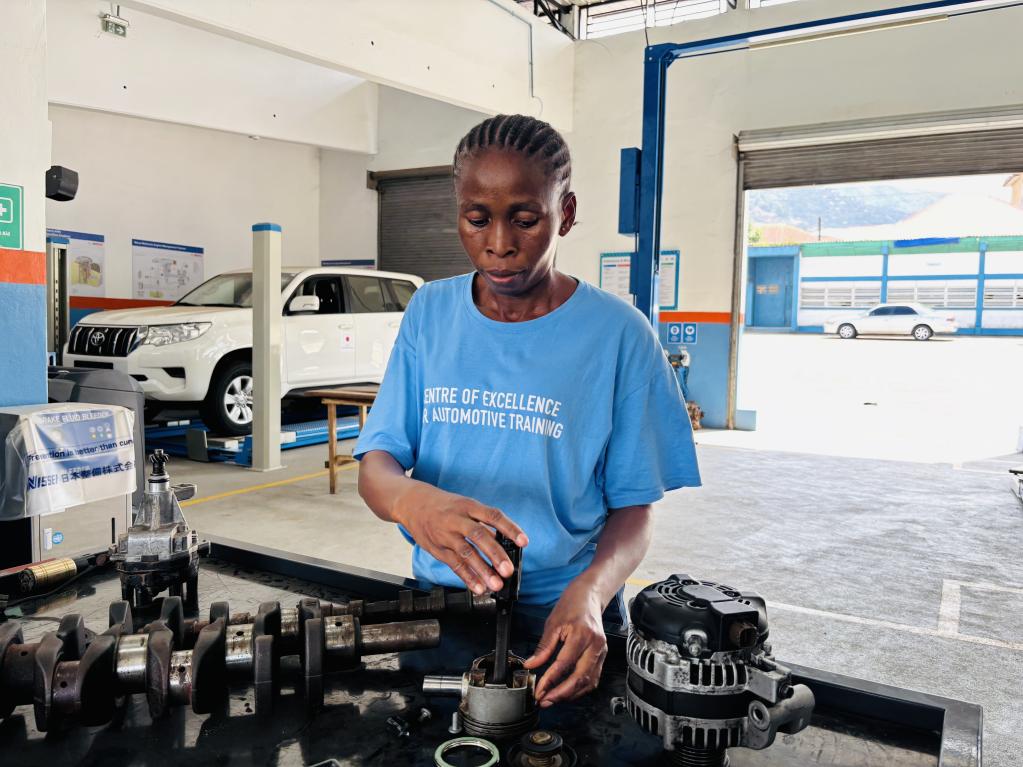
The Centre of Excellence for Automotive Training at Freetown Polytechnic, Kissy Campus, is inspiring young Sierra Leoneans to explore careers in the automotive sector. Throughout 2025, the Centre has conducted an awareness campaign promoting automotive skills as a pathway to youth empowerment and encouraging greater female participation in a field traditionally dominated by men.As part of the outreach, students and trainers appeared on the Sierra Leone Broadcasting Corporation (SLBC) Morning Show in October to showcase the Centre’s programs and hands-on training. Automotive trainer Dauda Saio Bangura, with students Posseh M. Kamara and Kai Bangura, shared how practical learning builds confidence and prepares students for employment in the automotive sector.Posseh highlighted women’s capabilities in automotive work: “People often say car repair is men’s work, but that’s not true. Once women get the training, we can do the job just like men.” Kai added, “Training here has shown me that with skills and determination, we can create opportunities for ourselves and lead change in our communities.” Female enrollment at the Centre now represents nearly 30 percent of students, reflecting progress in challenging the perception that automotive work is only for men. The appearance of students and trainers on the SLBC Morning Show forms part of a wider awareness campaign that includes community outreach, school engagements, media features, and targeted materials promoting women’s participation. Through these combined efforts, the Centre remains committed to further expanding female enrollment and breaking barriers that have historically limited women’s entry into the sector.Students like Abdul Turay and Adama Tarawally illustrate the Centre’s impact. Abdul said, “Before, I didn’t know most of the things in class. But now, I’ve learned how to use a tracking machine and computer-based diagnostic tools. This makes our work faster and easier.” He hopes to start his own automotive workshop after graduation, supported by the Centre’s entrepreneurship training. Adama, shared how the program has built her confidence and skillset. “I came here to learn how to repair vehicles. My proudest moments so far have been working on piston and crankshaft assemblies, which shows all the skills I’ve gained and the progress I’ve made during my time here,” she said. Her experience reflects the Centre’s broader commitment to empowering women through access to quality technical education.The Centre’s 1,000-hour programme combines theory with practice, with 70 percent hands-on training and 40 hours of entrepreneurship instruction. Students gain direct experience with industry-standard tools, graduating with the skills and confidence to enter the workforce or start their own businesses.The Centre was recently renovated and transformed into a state-of-the-art facility under the project “Promoting Youth Employment through Automotive Maintenance Skills Training.” The project is implemented by UNIDO in partnership with the Ministry of Technical and Higher Education and the Ministry of Youth Affairs and generously funded by the Government of Japan.Through practical training, mentorship, entrepreneurship education, and outreach, the Centre is helping young Sierra Leoneans turn skills into opportunity. By promoting gender inclusion and strengthening technical education, it is preparing the next generation of professionals to drive innovation and growth in Sierra Leone’s automotive industry.
1 of 5
Press Release
27 January 2026
SOGREA Initiative Opens Call for Private Sector Developers to Fast-Track Rural Electrification in Sierra Leone
Freetown, 26 January 2026: The Salone Off-Grid Renewable Energy Acceleration (SOGREA) Initiative today launched its first Call for Pre-Qualification Applications, inviting private sector companies to develop and upgrade green mini-grids in rural communities across Sierra Leone. The call marks a major step forward in accelerating universal energy access while unlocking new opportunities for renewable energy investors and developers.
Delivered in partnership with the Government of Sierra Leone, SOGREA aims to crowd in private capital to expand clean, reliable electricity to underserved communities, strengthening local economies and supporting climate-resilient development. The announcement was made during a live-streamed event hosted by Sustainable Energy for All (SEforALL) marking the International Day of Clean Energy.
The SOGREA is funded by the European Union and the Government of Denmark and totals EUR 24 million in catalytic funding. The three-year programme is designed to reduce investment risk and boost the commercial viability of rural electrification in Sierra Leone. The initiative provides performance-based capital support to cover a portion of upfront development costs for green mini-grids, with payments released against independently verified milestones.
By bridging the gap between the true cost of electricity supply and what rural households and businesses can afford, SOGREA helps lower tariffs while expanding connections. The approach builds on Sierra Leone’s recent mini-grid sector reforms, including progressive regulation and transparent tariff-setting mechanisms that provide long-term certainty for investors.
The Call for Pre-Qualification Applications is open to eligible applicants, who are licensed, for-profit mini-grid developers registered to operate in Sierra Leone, with proven experience operating green mini-grids in Sub-Saharan Africa, the capacity to deliver new projects within 12 months, smart-meter integration capability, compliance with UEF requirements and at least 30% female representation across administrative and operational roles. Applications are accepted on a rolling basis, with Pre-Qualification submissions closing on 9 March 2026. Successfully pre-qualified companies will be invited to submit site-specific proposals for development of new or upgrade of already existing green mini-grid projects. Funding decisions will be made on a first-come, first-served basis until available resources are fully allocated.
This performance-based capital support reflects the EU and Denmark’s commitment to advancing clean energy access, sustainable investment and climate action in Africa. The initiative is implemented by UNOPS, with its host entity Sustainable Energy for All, in close partnership with the Government of Sierra Leone. For application guidelines, eligibility criteria, and submission details, please visit the SOGREA webpage: http://www.universalenergyfacility.org/programme/sogrea or contact us via: UEF@seforall.org.
QUOTES
Hon. Cyril Arnold Grant, Minister of Energy in Sierra Leone:
“The Ministry of Energy expresses its appreciation to the European Union and the Government of Denmark for the funding support provided, including resources allocated to SOGREA, which will play a critical role in advancing sector reforms and accelerating access to sustainable energy solutions. This partnership reflects our shared commitment to strengthening institutional capacity and delivering lasting benefits to communities nationwide.”
Dr Kandeh Yumkella, Chairman of the Presidential Initiative on Climate Change, Renewable Energy and Food Security (PI-CREF):
“This contribution reinforces our collective efforts to accelerate Sierra Leone’s energy sector reforms, expand access to reliable and affordable electricity and crowd in private sector investment. By aligning donor resources with national priorities, we are laying the foundation for a resilient, inclusive and sustainable energy system that supports economic growth and social development.
We value the European Union and Denmark’s continued partnership and remain committed to ensuring that these resources deliver measurable, high-impact outcomes for the people of Sierra Leone.”
H.E. Jakob Linulf, Ambassador of Denmark to Ghana:
“The Government of Denmark is pleased to support Sierra Leone’s energy transition, in line with our shared commitment under the Accelerated Partnership for Renewables in Africa. Access to green energy is vital to the green transition, and essential for achieving the Sustainable Development Goals. With affordable, reliable, and sustainable energy through green mini-grids, Sierra Leone can unlock innovation, empower youth, attract investment, and transform its economy.”
H.E. Jacek Jankowski, Ambassador of the European Union to Sierra Leone:
"The investment support provided under SOGREA clearly demonstrates Team Europe's commitment to a green transition. We recognize that successful rural electrification requires more than just funding; it demands a strategic partnership between visionary government leadership and efficient private sector involvement. Through the Global Gateway —the European Union's comprehensive offer to close the development financing gap, we are working to deepen connectivity and sustainable development across Sierra Leone. We are proud to collaborate with the Government of Sierra Leone to provide rural communities with the clean, reliable power essential for socio-economic growth. By de-risking investments and offering tangible incentives through CAPEX support, we have created a scalable model that we believe can serve as a benchmark for the entire region. We invite the private sector to join us in this mission to providing power to communities nationwide, fostering a more resilient and prosperous future for all."
UNOPS Representative: Silvia Gallo, Regional Director for West Africa Multi-Country Office:
"Investing in reliable energy means transforming lives. Through SOGREA, we will bring clean, reliable electricity to households, schools, clinics and small businesses in communities that have waited too long. This initiative demonstrates the lasting social and economic benefits that are possible when governments, development partners and the private sector work together. By mobilizing private investment and strengthening local energy markets, we are expanding electricity access and laying the foundation for long-term economic growth and sustainable development."
Anita Otubu, Senior Director of the Universal Energy Facility, Sustainable Energy for All:
“The Universal Energy Facility (UEF) continues to demonstrate the transformative power of Results-Based Financing to de-risk private investment, accelerate energy access, and support rural economic development. The UEF is proud to be one of the most effective and innovative catalytic finance platforms operating today, having mobilized more than US$74 million towards energy access projects since 2020.
We deliver measurable, lasting impact through an ecosystem approach – mobilizing public and private capital, strengthening government institutional capacity and enacting progressive policy frameworks that enable communities to reach their full potential. Looking ahead, we aim to deepen collaboration with our global partners and unlock new partnerships as we expand our work across sub-Saharan Africa, Latin America, and Asia - ensuring clean energy access for everyone, everywhere.”
– END –
Note to Editors.
About the SOGREA initiative
The Salone Off-Grid Renewable Energy Acceleration (SOGREA) initiative supports Sierra Leone’s transition to clean, affordable, and reliable energy by strengthening governance, scaling investments in mini-grids, and piloting innovative renewable energy solutions.
Media Contacts:
The Ministry of Energy, Government of Sierra Leone
Austine Luseni, Communication Specialist, Ministry of Energy
austineluseni@gmail.com | +232 34 157 390
The Presidential Initiative on Climate Change, Renewable Energy and Food Security (PI-CREF): Anthony Kamara, Director of Partnerships, Communications and Outreach
akkamara@statehouse.gov.sl | +232 78 107 303
Delegation of the European Union to Sierra Leone:
N’fa Alie Koroma, Political Press & Information Officer
N'Fa-Alie.Koroma@eeas.europa.eu | +232 88 136 002
UNOPS:
Victoria Chendeka - Communications Officer,
UNOPS Sierra Leone Victoriak@unops.org | +232 30 882 151
Sustainable Energy for All and the Universal Energy Facility:
Sherry Kennedy, Director of Communications:
Sherry.Kennedy@SEforALL.org | +43 676 486 2425
About the Ministry of Energy, Government of Sierra Leone
The Ministry’s guiding mission is to develop, regulate, and promote a sustainable, reliable, and affordable energy sector that supports national development, drives economic growth, and improves the quality of life for all Sierra Leoneans through transparent governance, effective service delivery, and strategic partnerships.
About PI-CREF The Presidential Initiative on Climate Change, Renewable Energy and Food Security (PI-CREF) plays a critical role in guiding and coordinating efforts to address the impacts of climate change, catalyse universal access to sustainable and affordable energy, and improve food and nutrition security in the country.
About the European Union Delegation to Sierra Leone
The European Union and its Member States are committed to supporting Sierra Leone’s transition to a sustainable energy future. Through the Development Partnership and the Multiannual Indicative Programme for 2021-2027, the EU focuses on providing access to affordable, reliable, and modern energy services. This initiative aims to drive inclusive economic growth, create decent jobs, and promote the adoption of sustainable energy sources, fostering a green economy across Sierra Leone.
About The Government of Denmark
The Government of Denmark supports Sierra Leone’s transition to a sustainable energy future through its development cooperation and in close partnership with the European Union. In line with Denmark’s Africa Strategy, Denmark promotes access to affordable, reliable, and renewable energy—particularly through decentralized solutions such as green mini-grids—to drive inclusive economic growth, strengthen livelihoods, and support climate mitigation in line with national priorities and the Accelerated Partnership for Renewables in Africa (APRA).
About UNOPS
UNOPS offers practical solutions across peace and security, humanitarian and development operations. We help the United Nations, governments, and other partners, such as the European Union and its Member States, manage projects and deliver sustainable infrastructure and procurement globally. Read more: www.unops.org.
About The Universal Energy Facility (UEF)
The Universal Energy Facility (UEF), a multi-donor fund managed by Sustainable Energy for All (SEforALL), was established in 2020 to accelerate and scale up energy access across Sub-Saharan Africa and beyond, in line with SDG7 and the Paris Agreement on Climate Change. The UEF provides incentive payments to clean energy companies deploying energy solutions and providing verified end-user electricity connections (via mini-grids and stand-alone solar systems) and clean cooking solutions based on pre-determined service standards. Read more: https://www.universalenergyfacility.org.
About SEforALL
Sustainable Energy for All has a global mandate to accelerate progress on the energy transition in emerging and developing countries. Hosted by UNOPS, we work at the intersection of energy, climate and development, partnering with governments and organisations worldwide to end energy poverty, double energy efficiency, significantly expand renewable energy and combat climate change. Read more: https://www.seforall.
Delivered in partnership with the Government of Sierra Leone, SOGREA aims to crowd in private capital to expand clean, reliable electricity to underserved communities, strengthening local economies and supporting climate-resilient development. The announcement was made during a live-streamed event hosted by Sustainable Energy for All (SEforALL) marking the International Day of Clean Energy.
The SOGREA is funded by the European Union and the Government of Denmark and totals EUR 24 million in catalytic funding. The three-year programme is designed to reduce investment risk and boost the commercial viability of rural electrification in Sierra Leone. The initiative provides performance-based capital support to cover a portion of upfront development costs for green mini-grids, with payments released against independently verified milestones.
By bridging the gap between the true cost of electricity supply and what rural households and businesses can afford, SOGREA helps lower tariffs while expanding connections. The approach builds on Sierra Leone’s recent mini-grid sector reforms, including progressive regulation and transparent tariff-setting mechanisms that provide long-term certainty for investors.
The Call for Pre-Qualification Applications is open to eligible applicants, who are licensed, for-profit mini-grid developers registered to operate in Sierra Leone, with proven experience operating green mini-grids in Sub-Saharan Africa, the capacity to deliver new projects within 12 months, smart-meter integration capability, compliance with UEF requirements and at least 30% female representation across administrative and operational roles. Applications are accepted on a rolling basis, with Pre-Qualification submissions closing on 9 March 2026. Successfully pre-qualified companies will be invited to submit site-specific proposals for development of new or upgrade of already existing green mini-grid projects. Funding decisions will be made on a first-come, first-served basis until available resources are fully allocated.
This performance-based capital support reflects the EU and Denmark’s commitment to advancing clean energy access, sustainable investment and climate action in Africa. The initiative is implemented by UNOPS, with its host entity Sustainable Energy for All, in close partnership with the Government of Sierra Leone. For application guidelines, eligibility criteria, and submission details, please visit the SOGREA webpage: http://www.universalenergyfacility.org/programme/sogrea or contact us via: UEF@seforall.org.
QUOTES
Hon. Cyril Arnold Grant, Minister of Energy in Sierra Leone:
“The Ministry of Energy expresses its appreciation to the European Union and the Government of Denmark for the funding support provided, including resources allocated to SOGREA, which will play a critical role in advancing sector reforms and accelerating access to sustainable energy solutions. This partnership reflects our shared commitment to strengthening institutional capacity and delivering lasting benefits to communities nationwide.”
Dr Kandeh Yumkella, Chairman of the Presidential Initiative on Climate Change, Renewable Energy and Food Security (PI-CREF):
“This contribution reinforces our collective efforts to accelerate Sierra Leone’s energy sector reforms, expand access to reliable and affordable electricity and crowd in private sector investment. By aligning donor resources with national priorities, we are laying the foundation for a resilient, inclusive and sustainable energy system that supports economic growth and social development.
We value the European Union and Denmark’s continued partnership and remain committed to ensuring that these resources deliver measurable, high-impact outcomes for the people of Sierra Leone.”
H.E. Jakob Linulf, Ambassador of Denmark to Ghana:
“The Government of Denmark is pleased to support Sierra Leone’s energy transition, in line with our shared commitment under the Accelerated Partnership for Renewables in Africa. Access to green energy is vital to the green transition, and essential for achieving the Sustainable Development Goals. With affordable, reliable, and sustainable energy through green mini-grids, Sierra Leone can unlock innovation, empower youth, attract investment, and transform its economy.”
H.E. Jacek Jankowski, Ambassador of the European Union to Sierra Leone:
"The investment support provided under SOGREA clearly demonstrates Team Europe's commitment to a green transition. We recognize that successful rural electrification requires more than just funding; it demands a strategic partnership between visionary government leadership and efficient private sector involvement. Through the Global Gateway —the European Union's comprehensive offer to close the development financing gap, we are working to deepen connectivity and sustainable development across Sierra Leone. We are proud to collaborate with the Government of Sierra Leone to provide rural communities with the clean, reliable power essential for socio-economic growth. By de-risking investments and offering tangible incentives through CAPEX support, we have created a scalable model that we believe can serve as a benchmark for the entire region. We invite the private sector to join us in this mission to providing power to communities nationwide, fostering a more resilient and prosperous future for all."
UNOPS Representative: Silvia Gallo, Regional Director for West Africa Multi-Country Office:
"Investing in reliable energy means transforming lives. Through SOGREA, we will bring clean, reliable electricity to households, schools, clinics and small businesses in communities that have waited too long. This initiative demonstrates the lasting social and economic benefits that are possible when governments, development partners and the private sector work together. By mobilizing private investment and strengthening local energy markets, we are expanding electricity access and laying the foundation for long-term economic growth and sustainable development."
Anita Otubu, Senior Director of the Universal Energy Facility, Sustainable Energy for All:
“The Universal Energy Facility (UEF) continues to demonstrate the transformative power of Results-Based Financing to de-risk private investment, accelerate energy access, and support rural economic development. The UEF is proud to be one of the most effective and innovative catalytic finance platforms operating today, having mobilized more than US$74 million towards energy access projects since 2020.
We deliver measurable, lasting impact through an ecosystem approach – mobilizing public and private capital, strengthening government institutional capacity and enacting progressive policy frameworks that enable communities to reach their full potential. Looking ahead, we aim to deepen collaboration with our global partners and unlock new partnerships as we expand our work across sub-Saharan Africa, Latin America, and Asia - ensuring clean energy access for everyone, everywhere.”
– END –
Note to Editors.
About the SOGREA initiative
The Salone Off-Grid Renewable Energy Acceleration (SOGREA) initiative supports Sierra Leone’s transition to clean, affordable, and reliable energy by strengthening governance, scaling investments in mini-grids, and piloting innovative renewable energy solutions.
Media Contacts:
The Ministry of Energy, Government of Sierra Leone
Austine Luseni, Communication Specialist, Ministry of Energy
austineluseni@gmail.com | +232 34 157 390
The Presidential Initiative on Climate Change, Renewable Energy and Food Security (PI-CREF): Anthony Kamara, Director of Partnerships, Communications and Outreach
akkamara@statehouse.gov.sl | +232 78 107 303
Delegation of the European Union to Sierra Leone:
N’fa Alie Koroma, Political Press & Information Officer
N'Fa-Alie.Koroma@eeas.europa.eu | +232 88 136 002
UNOPS:
Victoria Chendeka - Communications Officer,
UNOPS Sierra Leone Victoriak@unops.org | +232 30 882 151
Sustainable Energy for All and the Universal Energy Facility:
Sherry Kennedy, Director of Communications:
Sherry.Kennedy@SEforALL.org | +43 676 486 2425
About the Ministry of Energy, Government of Sierra Leone
The Ministry’s guiding mission is to develop, regulate, and promote a sustainable, reliable, and affordable energy sector that supports national development, drives economic growth, and improves the quality of life for all Sierra Leoneans through transparent governance, effective service delivery, and strategic partnerships.
About PI-CREF The Presidential Initiative on Climate Change, Renewable Energy and Food Security (PI-CREF) plays a critical role in guiding and coordinating efforts to address the impacts of climate change, catalyse universal access to sustainable and affordable energy, and improve food and nutrition security in the country.
About the European Union Delegation to Sierra Leone
The European Union and its Member States are committed to supporting Sierra Leone’s transition to a sustainable energy future. Through the Development Partnership and the Multiannual Indicative Programme for 2021-2027, the EU focuses on providing access to affordable, reliable, and modern energy services. This initiative aims to drive inclusive economic growth, create decent jobs, and promote the adoption of sustainable energy sources, fostering a green economy across Sierra Leone.
About The Government of Denmark
The Government of Denmark supports Sierra Leone’s transition to a sustainable energy future through its development cooperation and in close partnership with the European Union. In line with Denmark’s Africa Strategy, Denmark promotes access to affordable, reliable, and renewable energy—particularly through decentralized solutions such as green mini-grids—to drive inclusive economic growth, strengthen livelihoods, and support climate mitigation in line with national priorities and the Accelerated Partnership for Renewables in Africa (APRA).
About UNOPS
UNOPS offers practical solutions across peace and security, humanitarian and development operations. We help the United Nations, governments, and other partners, such as the European Union and its Member States, manage projects and deliver sustainable infrastructure and procurement globally. Read more: www.unops.org.
About The Universal Energy Facility (UEF)
The Universal Energy Facility (UEF), a multi-donor fund managed by Sustainable Energy for All (SEforALL), was established in 2020 to accelerate and scale up energy access across Sub-Saharan Africa and beyond, in line with SDG7 and the Paris Agreement on Climate Change. The UEF provides incentive payments to clean energy companies deploying energy solutions and providing verified end-user electricity connections (via mini-grids and stand-alone solar systems) and clean cooking solutions based on pre-determined service standards. Read more: https://www.universalenergyfacility.org.
About SEforALL
Sustainable Energy for All has a global mandate to accelerate progress on the energy transition in emerging and developing countries. Hosted by UNOPS, we work at the intersection of energy, climate and development, partnering with governments and organisations worldwide to end energy poverty, double energy efficiency, significantly expand renewable energy and combat climate change. Read more: https://www.seforall.
1 of 5
Press Release
14 December 2025
Un Agencies Weekly Highlights 1st -5th December
RCOUN Sierra Leone joins Ministry of Health on World Aids Day.UN Sierra Leone. Ministry of Health. CSO’s and development partners joined the global community to commemorate World AIDS Day under the theme “Overcoming Disruption, Transforming the AIDS Response,” reaffirming national and international commitment to end AIDS as a public health threat by 2030.The commemoration, held at Waterloo Government Hospital, brought together the Government of Sierra Leone, the United Nations family, development partners, civil society, and community leaders, demonstrating strong solidarity and collective resolve to sustain progress in the national HIV response.Emphasising the urgency of sustainability and national ownership, UNAIDS Country Representative Ms. Jane Kalweo delivered the message on behalf of the UN Resident Coordinator said “Ending AIDS by 2030 demands more than progress, it requires sustainability, national ownership, and health systems that place people at the centre,” She noted. “By integrating HIV services, investing in communities, and confronting stigma and inequality, we can protect the gains made and ensure no one is left behind.”The event concluded with the commissioning of the Wellness Clinic and a symbolic ribbon-cutting ceremony at Waterloo Government Hospital, reinforcing collective commitment to expanding access to integrated, equitable, and people-centred HIV services.UN Sierra Leone recognised by the Ministry of Social Welfare on the International Day of Persons with Disability.On the International Day of Persons with Disabilities (IDPD), marked on 3 December, the Government of Sierra Leone, through the Ministry of Social Welfare, recognised United Nations agencies for their contributions to strengthening disability inclusion and social protection systems nationwide. The recognition highlighted the collective efforts supporting national priorities that promote the rights, dignity, and full participation of persons with disabilities (PWDs) in Sierra Leone.Over recent years, the UN system has worked closely with Government institutions, civil society, and development partners to advance inclusive policies, services, and accountability frameworks, aligned with the Persons with Disabilities Act, the Medium-Term National Development Plan (MTNDP), and the 2030 Agenda for Sustainable Development.“We feel honoured to be recognised by the Ministry of Social Welfare at the International Day of Persons with Disability and we remain strongly committed to inclusion, empowerment, and leaving no one behind,” said Mona Korsgard, Chief of Social Policy at UNICEF Sierra Leone.Speaking on behalf of the UN Resident Coordinator, Mr. Robert Banamwama, Head of the Resident Coordinator’s Office, underscored that disability inclusion is a core development priority for the United Nations in Sierra Leone, rather than a standalone or sector-specific issue.During the commemoration, Mr. Robert Banamwama, received awards on behalf of UNDP and UNFPA, presented by Chief Minister Dr. David Moinina Sengeh, in recognition of their contributions to advancing disability inclusion, social protection, and equitable access to services in Sierra Leone.UNICEF was also recognised with an award for its sustained leadership in strengthening disability-inclusive social protection systems, including support to national assessment, certification, and child-focused inclusion initiatives. The awards underscored the collective impact of the United Nations system in supporting the Government’s commitment to inclusive development.UNDPYouth take center stage as Sierra Leone launches first status report.This week marked a powerful milestone for Sierra Leone’s young people. At Milton Margai Technical University (MMTU), His Excellency President Julius Maada Bio launched the first-ever Youth Status Report 2025. Alongside this, the President also inaugurated a major new initiative to provide vocational training for peace for 1,200 bike riders, transforming okadas into engines of peace and strengthening the role of young people in advancing stability and development.UNDP Resident Representative Fredrick Ampiah, serving in the role of Acting UN Resident Coordinator, joined government leaders, development partners, and youth representatives in reaffirming the UN’s commitment to empowering young people with the tools, opportunities, and platforms they need to thrive.With support from UNDP, UNCDF, the Ministry of Youth Affairs, Institute of Development and Humanitarian Assistance, MMTU, and the UN Peacebuilding Fund, this initiative offers young bike riders the chance to build new skills, strengthen their livelihoods, and contribute to peace within their communities. As youth gain skills, voice, and resilience, they are shaping a future defined not by challenges, but by possibility, and driving progress for a more peaceful and prosperous Sierra Leone.
Click below to read more.
Click below to read more.
1 of 5
Press Release
03 December 2025
UN Agencies Weekly Highlights 24-28th November 2025
UN WomenSierra Leone launches 16 Days of Activism against GBV.
On 25 November 2025 in Freetown, Sierra Leone, with support from the Government of Iceland, UN Women Sierra Leone, in partnership with the Ministry of Gender and Children’s Affairs and sister UN agencies, officially launched the 16 Days of Activism Against Gender-Based Violence under the global theme: “UNiTE to End Digital Violence against All Women and Girls.”
The campaign brings together government officials, development partners, civil society organisations, and community leaders and the media to raise awareness and strengthen support for survivors. Speaking at the national launch, Dr. Moinina Sengeh, Chief Minister of Sierra Leone, said, “Our Government through its laws from its leader the President, Dr. Julius Maada Bio to everyone of us reject every form of violence against All Women and Girls online and offline.” He called on all citizens to UNiTE in ending violence against women and girls, stressing that it is a collective responsibility. Representing Ms. Seraphine Wakana, UN Resident Coordinator in Sierra Leone, Mr. Fredrick Ampiah, Resident Representative for the United Nations Development Programme (UNDP). He affirmed, "The 16 Days of Activism is a clarion call to all of us: Development Partners, the UN, Government, and Civil Society. It demands tenacity of purpose and unwavering commitment. As the United Nations, we reaffirm our dedication to building a world where every woman and girl can live free from fear, both offline and online."
According to Dr. Isata Mahoi, Minister of Gender and Children’s Affairs, ending violence against women and girls is not solely a women’s issue, but a collective moral duty and a fundamental human rights obligation. She emphasised that violence in any form undermines national development, weakens families and communities, and erodes the dignity and safety of society as a whole. The UN family, reaffirms its unwavering commitment to working with Government, UN agencies, civil society, the private sector, and communities to prevent violence in both physical and digital spaces. UNDP
UNDP drives action on gender equality as the 16 Days of Activism begin.
As we mark the start of the 16 Days of Activism against Gender-Based Violence, a global campaign calling for the elimination of violence in all its forms. Technology and social media increasingly become tools for harassment and abuse, digital spaces have emerged as a critical frontline in protecting the rights, safety, and dignity of women and girls.
In parallel with national advocacy efforts, UNDP Sierra Leone convened a staff consultative meeting on UNDP’s Global Gender Equality Strategy, with technical support from the Regional Bureau for Africa Gender Team.The session highlighted that while gender equality remains central to Sierra Leone’s development agenda, deeply rooted socio-cultural norms, limited digital access for women, and low representation in leadership continue to restrict opportunities for women and girls. UNFPAUNFPA and partners engage students to end digital violence.
As part of the 16 Days of Activism against Gender-Based Violence, UNFPA Sierra Leone, in partnership with the Ministry of Gender and Children’s Affairs, UN Women, WHO, the National Cyber Security Coordination Centre (NC3), and the Embassy of Iceland, engaged students at Fourah Bay College to tackle technology-facilitated gender-based violence (TFGBV).
The event brought together students, university leadership, government officials, and youth advocates for interactive sessions, panel discussions, and creative student-led performances. Participants explored the forms and impacts of digital violence and gained practical tools to prevent abuse online. “Young people have the strongest voice in shaping the future of Sierra Leone,” said UNFPA Country Representative Kunle Adeniyi. “When you stand for Bodyright, you stand for safety, dignity, and a future where technology works for people, not against them.”Knoxforda Ayodele Glynis Nicol, Secretary of the Gender Equity Society at Fourah Bay College, delivered a vote of thanks: “We leave here more informed, more empowered, and ready to take action. Together, we can make our online spaces safer for all women and girls.” Click below to read more.
On 25 November 2025 in Freetown, Sierra Leone, with support from the Government of Iceland, UN Women Sierra Leone, in partnership with the Ministry of Gender and Children’s Affairs and sister UN agencies, officially launched the 16 Days of Activism Against Gender-Based Violence under the global theme: “UNiTE to End Digital Violence against All Women and Girls.”
The campaign brings together government officials, development partners, civil society organisations, and community leaders and the media to raise awareness and strengthen support for survivors. Speaking at the national launch, Dr. Moinina Sengeh, Chief Minister of Sierra Leone, said, “Our Government through its laws from its leader the President, Dr. Julius Maada Bio to everyone of us reject every form of violence against All Women and Girls online and offline.” He called on all citizens to UNiTE in ending violence against women and girls, stressing that it is a collective responsibility. Representing Ms. Seraphine Wakana, UN Resident Coordinator in Sierra Leone, Mr. Fredrick Ampiah, Resident Representative for the United Nations Development Programme (UNDP). He affirmed, "The 16 Days of Activism is a clarion call to all of us: Development Partners, the UN, Government, and Civil Society. It demands tenacity of purpose and unwavering commitment. As the United Nations, we reaffirm our dedication to building a world where every woman and girl can live free from fear, both offline and online."
According to Dr. Isata Mahoi, Minister of Gender and Children’s Affairs, ending violence against women and girls is not solely a women’s issue, but a collective moral duty and a fundamental human rights obligation. She emphasised that violence in any form undermines national development, weakens families and communities, and erodes the dignity and safety of society as a whole. The UN family, reaffirms its unwavering commitment to working with Government, UN agencies, civil society, the private sector, and communities to prevent violence in both physical and digital spaces. UNDP
UNDP drives action on gender equality as the 16 Days of Activism begin.
As we mark the start of the 16 Days of Activism against Gender-Based Violence, a global campaign calling for the elimination of violence in all its forms. Technology and social media increasingly become tools for harassment and abuse, digital spaces have emerged as a critical frontline in protecting the rights, safety, and dignity of women and girls.
In parallel with national advocacy efforts, UNDP Sierra Leone convened a staff consultative meeting on UNDP’s Global Gender Equality Strategy, with technical support from the Regional Bureau for Africa Gender Team.The session highlighted that while gender equality remains central to Sierra Leone’s development agenda, deeply rooted socio-cultural norms, limited digital access for women, and low representation in leadership continue to restrict opportunities for women and girls. UNFPAUNFPA and partners engage students to end digital violence.
As part of the 16 Days of Activism against Gender-Based Violence, UNFPA Sierra Leone, in partnership with the Ministry of Gender and Children’s Affairs, UN Women, WHO, the National Cyber Security Coordination Centre (NC3), and the Embassy of Iceland, engaged students at Fourah Bay College to tackle technology-facilitated gender-based violence (TFGBV).
The event brought together students, university leadership, government officials, and youth advocates for interactive sessions, panel discussions, and creative student-led performances. Participants explored the forms and impacts of digital violence and gained practical tools to prevent abuse online. “Young people have the strongest voice in shaping the future of Sierra Leone,” said UNFPA Country Representative Kunle Adeniyi. “When you stand for Bodyright, you stand for safety, dignity, and a future where technology works for people, not against them.”Knoxforda Ayodele Glynis Nicol, Secretary of the Gender Equity Society at Fourah Bay College, delivered a vote of thanks: “We leave here more informed, more empowered, and ready to take action. Together, we can make our online spaces safer for all women and girls.” Click below to read more.
1 of 5
Press Release
26 November 2025
Un Agencies Weekly Highlights 17-21st November 2025
WHO
Multi-Age HPV vaccine campaign begins nationwide.
Sierra Leone has launched a nationwide HPV Multi-Age Cohort (MAC) vaccination campaign to protect girls aged 11–18 and accelerate the elimination of cervical cancer. Launched on 17 November in Freetown, the campaign builds on the HPV vaccine’s 2022 introduction into routine immunization and aligns with the WHO’s global 90-70-90 targets. With strong government leadership and support from the UN, Gavi, WHO and civil society, the initiative combines vaccination, screening and treatment to safeguard the health of girls and women nationwide.
UNDP
UNDP launches Regional Cooperative Credit Union in Kenema.
UNDP Sierra Leone, in partnership with Irish Aid, Government partners, SEND Sierra Leone and traditional leaders, has launched the Regional Cooperative Credit Union in Kenema to expand access to finance for women, youth and local entrepreneurs. With only 15.1% of adults accessing formal financial services nationally, the new Kakebu Financial Services Cooperative marks a major step toward closing the financial inclusion gap. Built on UNDP–SEND initiatives supporting village savings groups and youth skills development, the cooperative opens new pathways for savings, enterprise growth and community-driven development across the region.
UNFPA
Experts convened to validate Sierra Leone’s Power of Data Country Implementation Framework.The Ministry of Planning and Economic Development, with Statistics Sierra Leone and UNFPA, has validated the final draft of Sierra Leone’s Power of Data (PoD) Country Implementation Framework. The framework, part of the global PoD Initiative launched at the 2023 SDG Summit, will strengthen the use of coordinated, gender-sensitive and disaggregated data for evidence-based policymaking. It provides a clear roadmap to enhance the national data ecosystem and track progress toward national priorities and the SDGs.Click below to read more.
Multi-Age HPV vaccine campaign begins nationwide.
Sierra Leone has launched a nationwide HPV Multi-Age Cohort (MAC) vaccination campaign to protect girls aged 11–18 and accelerate the elimination of cervical cancer. Launched on 17 November in Freetown, the campaign builds on the HPV vaccine’s 2022 introduction into routine immunization and aligns with the WHO’s global 90-70-90 targets. With strong government leadership and support from the UN, Gavi, WHO and civil society, the initiative combines vaccination, screening and treatment to safeguard the health of girls and women nationwide.
UNDP
UNDP launches Regional Cooperative Credit Union in Kenema.
UNDP Sierra Leone, in partnership with Irish Aid, Government partners, SEND Sierra Leone and traditional leaders, has launched the Regional Cooperative Credit Union in Kenema to expand access to finance for women, youth and local entrepreneurs. With only 15.1% of adults accessing formal financial services nationally, the new Kakebu Financial Services Cooperative marks a major step toward closing the financial inclusion gap. Built on UNDP–SEND initiatives supporting village savings groups and youth skills development, the cooperative opens new pathways for savings, enterprise growth and community-driven development across the region.
UNFPA
Experts convened to validate Sierra Leone’s Power of Data Country Implementation Framework.The Ministry of Planning and Economic Development, with Statistics Sierra Leone and UNFPA, has validated the final draft of Sierra Leone’s Power of Data (PoD) Country Implementation Framework. The framework, part of the global PoD Initiative launched at the 2023 SDG Summit, will strengthen the use of coordinated, gender-sensitive and disaggregated data for evidence-based policymaking. It provides a clear roadmap to enhance the national data ecosystem and track progress toward national priorities and the SDGs.Click below to read more.
1 of 5
Press Release
19 November 2025
UN Agencies Weekly Highlights 10-14th November 2025
RCO
The second Steering Committee meeting of the UNSDCF 2025–2030 convened this week, co-chaired by the UN Resident Coordinator, Seraphine Wakana, and the Minister of Planning and Economic Development (MoPED), Ms. Kenyeh Barlay. The UN RC emphasised the strong alignment between the Cooperation Framework and the Mid-Term National Development Plan, highlighting global development financing shifts and the role of UN 2.0 reforms in strengthening collaboration and delivery across the UN system.Ms. Barlay reaffirmed the Government’s commitment to deepening its partnership with the UN. The Committee also reviewed follow-up actions from the previous meeting, including the completion of the joint funding analysis by MoPED and the national environmental data team that helps assess how development plans impact people and the environment, updates to the Steering Committee’s Terms of Reference, and preparations for joint field visits. Members further welcomed the Government’s increased budget allocation to the School Feeding Programme, with MoPED set to assess its impact later this year.A mid-year progress update was presented, capturing achievements and ongoing funding needs across all pillars. Development partners encouraged strengthened coordination, particularly around the Nationally Determined Contribution (NDC 3.0), alongside improved results demonstration, investment in resilient infrastructure, enhanced disability-inclusive data, and stronger food system value chains. The UN RC noted key achievements emerging from recent technical workshops, including the HoRCO-led session by Robert Banamwana on mid-year Cooperation Framework results, which clarified reporting timelines and harmonised approaches across Results Groups. Another workshop, led by the Permanent Secretary of MoPED, provided a detailed overview of the Peacebuilding Fund (PBF) Ms. Abie Kamara re-eligibility process, outlining progress on governance arrangements, evaluations, and conflict analyses ahead of the 2025 submission.The Committee endorsed a high-level UN-Government joint field visit planned for early next year. Results Groups, together with MoPED, will refine the concept note and ensure the participation of non-government partners to strengthen collective oversight of UNSDCF delivery.The meeting closed with a shared commitment to bolstering coordination, improving results reporting, and advancing activity mapping across pillars in preparation for the joint field mission, while maintaining close engagement with PBF partners as the re-eligibility process moves forward. WHOStakeholders validate draft tobacco and nicotine control regulations to strengthen enforcement in Sierra Leone. The Ministry of Health, in collaboration with the World Health Organisation (WHO), has concluded a three-day national workshop to review and validate the draft Tobacco and Nicotine Control Regulations under the Tobacco and Nicotine Control Act, 2022.Held from 10–12 November 2025 at the Sierra Palms Hotel in Freetown, the workshop brought together representatives from government ministries, agencies, civil society organisations, professional bodies, and the media to critically assess the draft regulations. These regulations are essential for the effective implementation and enforcement of the Act, which aims to reduce tobacco and nicotine use and protect public health in Sierra Leone. Deputy Minister of Health, Professor Charles Senessie, emphasised the urgency of addressing the increasing use of tobacco among young people, noting that clear and actionable regulations are crucial for effective enforcement. Marian Conte, Executive Officer at the Ministry of Technical and Higher Education, highlighted the importance of integrating tobacco control education into academic and vocational institutions to empower youth. She added, “This experience has strengthened my analytical and policy drafting skills and will prepare me for higher administrative responsibilities.” Participants reviewed key provisions related to advertising bans, packaging and labelling, smoke-free environments, taxation, licensing, and enforcement mechanisms to ensure alignment with the WHO Framework Convention on Tobacco Control (FCTC). WHO reaffirmed its continued support to the Government of Sierra Leone in advancing tobacco control and promoting a healthier, tobacco-free nation. UNDPYouth Bike Riders drive peacebuilding across communities. Last week, UNDP Sierra Leone accompanied Hon. Ibrahim Sannoh, Minister of Youth Affairs, on a monitoring visit to Kenema, Bo and Makeni, where they met beneficiaries of the Youth Bike Riders Project, a joint initiative supported by the UN Peacebuilding Fund and implemented in partnership with the United Nations Capital Development Fund (UNCDF). The visit offered the Minister an opportunity to hear first-hand testimonies from bike riders, the Sierra Leone Police and the Road Safety Authority on how the project is transforming lives and improving community relations. The Youth Bike Riders Project was designed to address the root causes of youth vulnerability by strengthening trust and cooperation between young people and state institutions. Through targeted training, dialogue and community engagement, the initiative has helped turn at-risk youth into agents of peace and social change. Beneficiaries shared how the project has improved their livelihoods, reduced tensions with law enforcement, and fostered a greater sense of belonging and mutual respect. These positive outcomes are contributing to enhanced social cohesion, community security, and a more peaceful environment across the country. By empowering youth and building bridges with state authorities, UNDP and its partners are helping to lay a stronger foundation for sustainable peace and inclusive development in Sierra Leone. Click below to read more.
The second Steering Committee meeting of the UNSDCF 2025–2030 convened this week, co-chaired by the UN Resident Coordinator, Seraphine Wakana, and the Minister of Planning and Economic Development (MoPED), Ms. Kenyeh Barlay. The UN RC emphasised the strong alignment between the Cooperation Framework and the Mid-Term National Development Plan, highlighting global development financing shifts and the role of UN 2.0 reforms in strengthening collaboration and delivery across the UN system.Ms. Barlay reaffirmed the Government’s commitment to deepening its partnership with the UN. The Committee also reviewed follow-up actions from the previous meeting, including the completion of the joint funding analysis by MoPED and the national environmental data team that helps assess how development plans impact people and the environment, updates to the Steering Committee’s Terms of Reference, and preparations for joint field visits. Members further welcomed the Government’s increased budget allocation to the School Feeding Programme, with MoPED set to assess its impact later this year.A mid-year progress update was presented, capturing achievements and ongoing funding needs across all pillars. Development partners encouraged strengthened coordination, particularly around the Nationally Determined Contribution (NDC 3.0), alongside improved results demonstration, investment in resilient infrastructure, enhanced disability-inclusive data, and stronger food system value chains. The UN RC noted key achievements emerging from recent technical workshops, including the HoRCO-led session by Robert Banamwana on mid-year Cooperation Framework results, which clarified reporting timelines and harmonised approaches across Results Groups. Another workshop, led by the Permanent Secretary of MoPED, provided a detailed overview of the Peacebuilding Fund (PBF) Ms. Abie Kamara re-eligibility process, outlining progress on governance arrangements, evaluations, and conflict analyses ahead of the 2025 submission.The Committee endorsed a high-level UN-Government joint field visit planned for early next year. Results Groups, together with MoPED, will refine the concept note and ensure the participation of non-government partners to strengthen collective oversight of UNSDCF delivery.The meeting closed with a shared commitment to bolstering coordination, improving results reporting, and advancing activity mapping across pillars in preparation for the joint field mission, while maintaining close engagement with PBF partners as the re-eligibility process moves forward. WHOStakeholders validate draft tobacco and nicotine control regulations to strengthen enforcement in Sierra Leone. The Ministry of Health, in collaboration with the World Health Organisation (WHO), has concluded a three-day national workshop to review and validate the draft Tobacco and Nicotine Control Regulations under the Tobacco and Nicotine Control Act, 2022.Held from 10–12 November 2025 at the Sierra Palms Hotel in Freetown, the workshop brought together representatives from government ministries, agencies, civil society organisations, professional bodies, and the media to critically assess the draft regulations. These regulations are essential for the effective implementation and enforcement of the Act, which aims to reduce tobacco and nicotine use and protect public health in Sierra Leone. Deputy Minister of Health, Professor Charles Senessie, emphasised the urgency of addressing the increasing use of tobacco among young people, noting that clear and actionable regulations are crucial for effective enforcement. Marian Conte, Executive Officer at the Ministry of Technical and Higher Education, highlighted the importance of integrating tobacco control education into academic and vocational institutions to empower youth. She added, “This experience has strengthened my analytical and policy drafting skills and will prepare me for higher administrative responsibilities.” Participants reviewed key provisions related to advertising bans, packaging and labelling, smoke-free environments, taxation, licensing, and enforcement mechanisms to ensure alignment with the WHO Framework Convention on Tobacco Control (FCTC). WHO reaffirmed its continued support to the Government of Sierra Leone in advancing tobacco control and promoting a healthier, tobacco-free nation. UNDPYouth Bike Riders drive peacebuilding across communities. Last week, UNDP Sierra Leone accompanied Hon. Ibrahim Sannoh, Minister of Youth Affairs, on a monitoring visit to Kenema, Bo and Makeni, where they met beneficiaries of the Youth Bike Riders Project, a joint initiative supported by the UN Peacebuilding Fund and implemented in partnership with the United Nations Capital Development Fund (UNCDF). The visit offered the Minister an opportunity to hear first-hand testimonies from bike riders, the Sierra Leone Police and the Road Safety Authority on how the project is transforming lives and improving community relations. The Youth Bike Riders Project was designed to address the root causes of youth vulnerability by strengthening trust and cooperation between young people and state institutions. Through targeted training, dialogue and community engagement, the initiative has helped turn at-risk youth into agents of peace and social change. Beneficiaries shared how the project has improved their livelihoods, reduced tensions with law enforcement, and fostered a greater sense of belonging and mutual respect. These positive outcomes are contributing to enhanced social cohesion, community security, and a more peaceful environment across the country. By empowering youth and building bridges with state authorities, UNDP and its partners are helping to lay a stronger foundation for sustainable peace and inclusive development in Sierra Leone. Click below to read more.
1 of 5
Latest Resources
1 / 11


1 / 11